

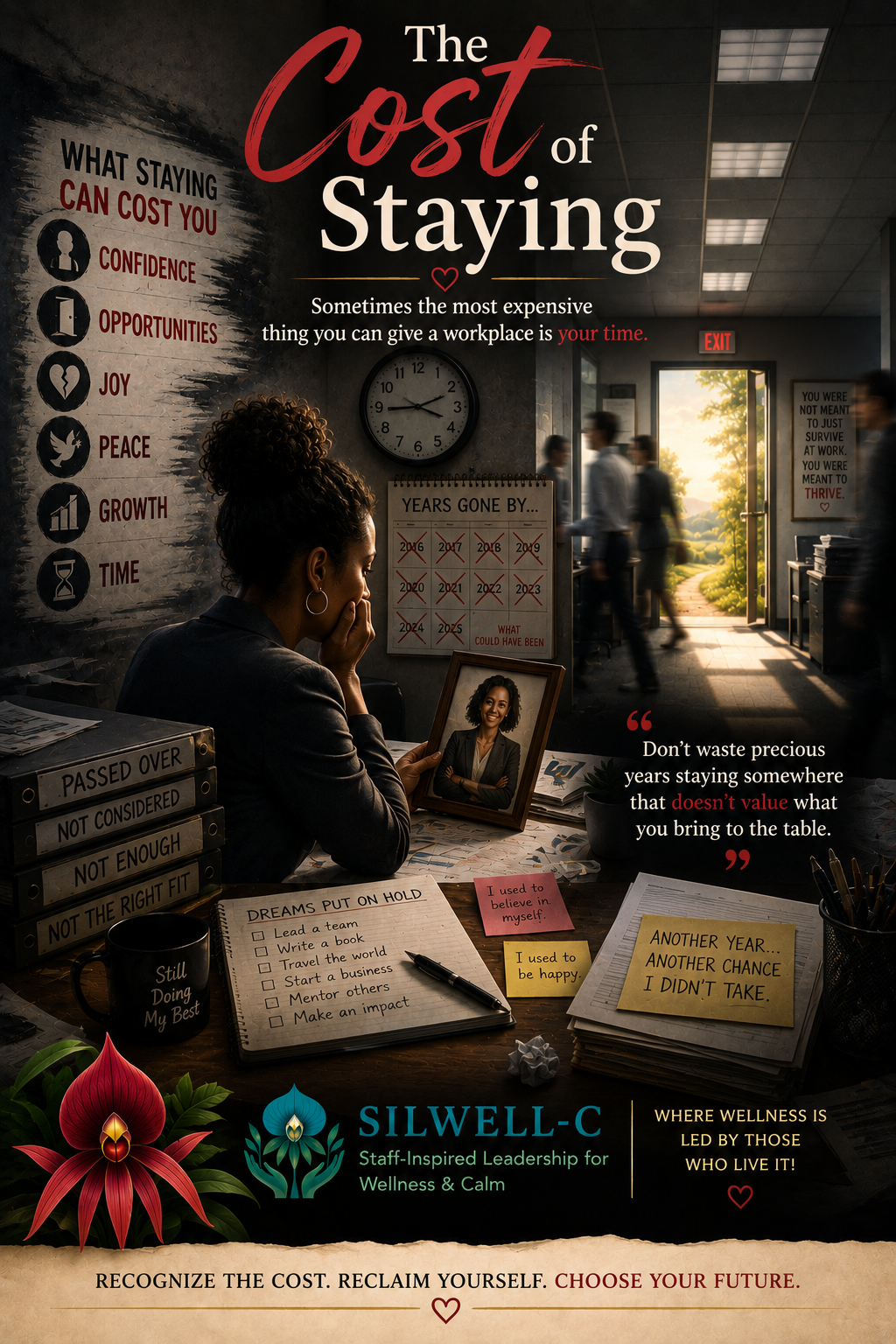
The Cost of Staying: Sometimes the Most Expensive Thing You Can Give a Workplace Is Your Time
We often calculate the cost of leaving a job, but rarely stop to calculate the cost of staying. Confidence, opportunities, joy, peace, growth, and precious years can slowly disappear while we wait for an unhealthy environment to change. The Cost of Staying asks us to consider a different question: If nothing changes, how much longer are you willing to pay the price?
Have you ever thought about what staying somewhere is costing you?
We talk a lot about the cost of leaving.
What will happen to my income?
What about my benefits?
What if I can't find another job?
What if I leave and regret it?
Those are real questions. And when you have bills, responsibilities, a family, or years invested in a career, they cannot simply be dismissed.
But there's another question we don't ask nearly enough:
What is it costing me to stay?
Because staying has a price too.
And sometimes we don't recognize how much we've paid until years have passed.
You Can Lose Confidence Without Realizing It
You can enter an organization knowing exactly what you bring to the table.
You're confident.
Knowledgeable.
Creative.
Driven.
You trust your decisions.
You know your skills.
Then you spend years in an environment where your ideas are dismissed, your knowledge is questioned, your contributions are minimized, or your growth is hindered instead of supported.
And slowly, something changes.
You start second-guessing yourself.
You hesitate before speaking.
You stop applying for opportunities because you're no longer sure you're qualified.
You begin wondering whether maybe everyone else knows something about you that you don't.
That's one of the hidden costs of staying.
An environment can repeat a message so many times that eventually you start repeating it to yourself.
You Can Lose Opportunities While Waiting for Things to Change
This one is difficult.
Sometimes we stay because we remember the good days.
You have a good week and think:
Maybe things are changing.
A leader is pleasant.
A meeting goes well.
Nobody creates conflict.
You laugh with your coworkers.
And suddenly there's hope again.
So you stay.
Another opportunity passes.
Then another.
And another.
Years can go by while you're waiting for an environment to become what you keep hoping it will be.
Meanwhile, there may be organizations looking for exactly what you bring.
Your knowledge.
Your experience.
Your creativity.
Your work ethic.
Your leadership.
Your authenticity.
But they'll never get the opportunity to meet that version of you if you're spending all of your energy trying to survive somewhere that doesn't recognize it.
You Can Lose Joy
This isn't talked about enough.
Sometimes an unhealthy workplace follows you home.
You physically leave the building, but emotionally you're still there.
You're talking about what happened.
Thinking about what happened.
Replaying conversations.
Preparing for tomorrow.
Trying to understand why someone behaved the way they did.
You carry the dark cloud home with you.
And eventually that cloud starts showing up everywhere.
You stop laughing as much.
You don't feel like going anywhere.
You don't have the energy for things you once enjoyed.
Even your face can begin carrying the exhaustion.
And that's when work has taken something it was never supposed to own:
your life outside of work.
You Can Lose Growth
Staying somewhere for a long time isn't automatically the same thing as growing there.
That's important.
You can work somewhere for ten years and still be professionally standing in the same place.
If nobody is developing you, challenging you in healthy ways, opening doors, mentoring you, encouraging your ideas, or helping you see possibilities beyond your current role, you may eventually become stagnant.
And sometimes we don't recognize stagnation because we're extremely busy.
We're working.
We're producing.
We're solving problems.
We're exhausted.
So it feels like we're moving.
But being busy and growing aren't always the same thing.
Employment Is an Exchange
I think workplaces sometimes forget this.
A job isn't an organization doing a human being a favor.
And an employee isn't doing the organization a favor either.
It's an exchange.
An organization has work that needs to be done.
You have knowledge, skills, experience, labor, creativity, and time that can help accomplish that work.
The organization compensates you for what you contribute.
Both sides bring something of value.
Receiving a paycheck doesn't mean you've surrendered your right to dignity.
Being employed doesn't mean you should be grateful for mistreatment.
And having bills doesn't make disrespect part of your job description.
You can appreciate your employment and still expect to be treated like a human being.
Those two things can exist at the same time.
Sometimes People Stay Because They Have To
This is where I want us to have compassion.
It is easy to tell somebody:
“Just leave.”
But leaving isn't always immediately possible.
People need insurance.
People have children.
People are supporting parents.
People have mortgages.
People are trying to reach retirement.
People may live somewhere with limited employment opportunities.
And sometimes people simply don't know what comes next.
So they stay.
They remain quiet.
They endure things they know aren't right because the bills still arrive every month.
That doesn't make them weak.
But it does mean organizations have an enormous responsibility not to exploit the fact that employees need their jobs.
Nobody should have to choose between being able to pay their bills and being treated with dignity.
Speaking Up Shouldn't Cost You Your Livelihood
One of the most damaging workplace cultures is one where employees believe:
If I say something, I'll become the problem.
So people stop talking.
They watch things happen.
They hear things.
They experience things.
But they remain quiet because they have seen what happens to people who challenge the system.
Whether that fear comes from actual retaliation, past experiences, or simply what employees have observed around them, the result is the same:
Silence becomes survival.
And when silence becomes survival, unhealthy behavior has room to become culture.
That's why healthy organizations need more than policies saying employees can speak.
Employees have to believe they can speak without being punished for speaking.
The Years Are the Part You Cannot Get Back
Money can sometimes be replaced.
A position can be replaced.
Benefits can change.
A career can be rebuilt.
But there is one thing none of us can recover.
Time.
That's what makes the cost of staying so important.
A year matters.
Five years matter.
Ten years matter.
Those are years of your life.
Years you could have been growing.
Creating.
Learning.
Laughing.
Traveling.
Building something.
Meeting new people.
Discovering another version of yourself.
That's why I think we have to stop asking only:
“Can I afford to leave?”
Sometimes we also need to ask:
“How much longer can I afford to stay?”
Don't Wait Until You Don't Recognize Yourself
There is something that can happen when you stay in an unhealthy environment too long.
Little pieces of you begin disappearing.
Not all at once.
That's why it's difficult to notice.
A little confidence here.
A little joy there.
One opportunity.
Another dream.
A boundary you stopped enforcing.
A part of your personality you learned to hide.
Until one day you look at yourself and think:
Who have I become?
That's when rebuilding begins.
And rebuilding is possible.
But I wish more people knew they didn't have to wait until they were completely depleted before deciding they deserved something different.
An Orchid Story Reflection 🌺
If you're currently struggling in an unhealthy workplace, I'm not going to tell you to quit tomorrow.
I'm going to ask you to take inventory.
Not just of your paycheck.
Of you.
What has staying cost you?
Has it cost you confidence?
Joy?
Peace?
Growth?
Opportunities?
Relationships?
Time?
Your belief in yourself?
And then ask yourself one more question:
If nothing about this environment changes, am I willing to pay this same price for another year?
If the answer is no, maybe you don't need to walk out tomorrow.
Maybe you need to start planning today.
Update the résumé.
Look at opportunities.
Build another skill.
Save what you can.
Reconnect with your network.
Explore something you've always wanted to do.
Start creating an exit instead of simply hoping for one.
Because your employer may own your time while you're working.
They do not own your future.
And no paycheck should quietly cost you so much of yourself that one day you look back and realize you gave away years waiting for people or an environment to become something they had repeatedly shown you they were not.
Sometimes leaving has a cost.
But so does staying.
And only you can decide which price you are willing to pay.
Have you ever stayed somewhere longer than you knew was healthy for you? Looking back, what did staying cost you?
If you feel comfortable, share your experience in the comments. These are conversations we need to have because too many people are silently paying a price that never appears on a paycheck.
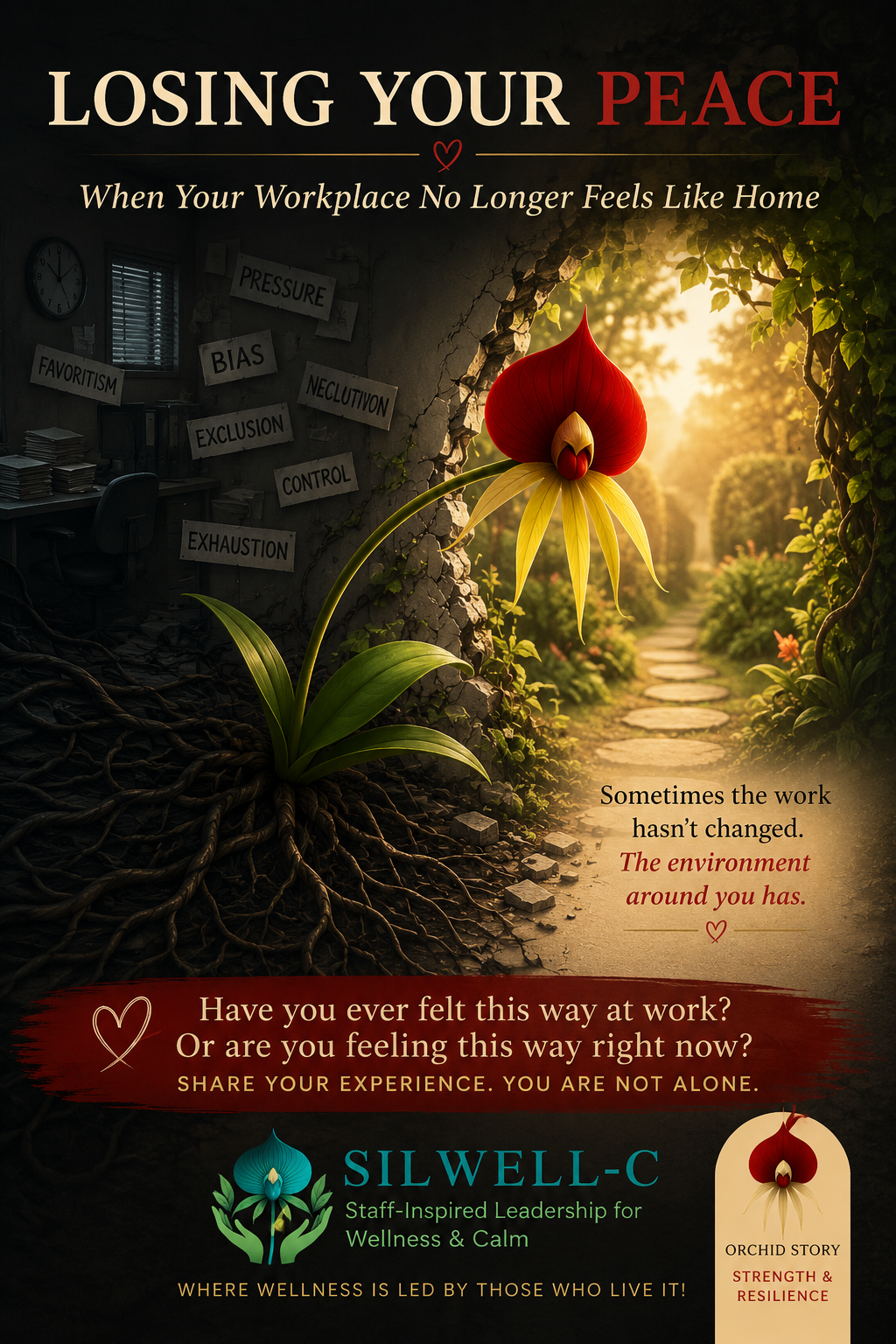
Losing Your Peace When Your Workplace No Longer Feels Like Home
What happens when a workplace you once loved no longer feels like home? Sometimes you don't stop loving the work. The environment around you changes, and slowly the passion, connection, and peace you once felt begin to disappear. This Orchid Story explores what it means to recognize an unhealthy workplace environment and find the strength to protect your peace.
Have you ever worked somewhere you once loved, but one day realized you didn't feel the same way about it anymore?
You still get up.
You still go to work.
You still do your job.
You answer the emails. You attend the meetings. You complete what needs to be completed. You smile when you need to smile. From the outside, it may even look like everything is okay.
But inside, something has changed.
You're just going through the motions.
You don't feel connected anymore. You don't look forward to being there. You don't feel the excitement you once felt about the work. You find yourself watching the clock because, more than anything, you just want to go home.
And sometimes you don't even realize when it happened.
You just know that somewhere along the way, you lost your peace.
When the Work Isn't the Problem
This is something I think we don't talk about enough.
Sometimes you don't stop loving the work.
You stop loving what you have to go through in order to do the work.
There is a difference.
You can still care deeply about the people you serve. You can still believe in the mission. You can still know that you're good at what you do.
But when you are surrounded by negativity day after day, eventually it starts clouding everything else.
The work you once loved is still there.
You just can't see it anymore.
That's why our work environment matters.
The energy people bring into a workplace matters. The way people communicate matters. The way conflict is handled matters. The way people treat one another when they disagree matters.
And leadership matters tremendously.
When People Bring Their Hurt to Work
We all come to work with a story.
None of us walks through the door without having experienced hurt, disappointment, loss, insecurity, or difficult things in our lives.
But there is a difference between having a story and allowing our unresolved hurt to become someone else's daily experience.
Sometimes people bring their pain into the workplace.
It may show up as control.
Favoritism.
Constant negativity.
The need to tear someone else down.
Inability to accept feedback.
Always needing to be right.
Treating certain people differently from others.
Creating division instead of connection.
And when those behaviors continue, everyone around that person begins experiencing the effects.
You may understand that someone is hurting.
You may even have compassion for what they have experienced.
But here's something I had to learn:
Understanding someone's hurt doesn't mean you have to become the place where they put it.
We cannot heal people who are unwilling or unable to address what is happening within themselves.
And we shouldn't have to lose ourselves trying.
When the Person Creating the Environment Is the Leader
This becomes even more difficult when harmful behavior comes from leadership.
A leader has influence over more than schedules, assignments, evaluations, or meetings.
Leaders influence how people feel when they come to work.
When leadership becomes centered around favoritism, bias, control, personal preferences, retaliation, exclusion, or choosing who deserves support and who doesn't, the impact doesn't stay between the leader and one employee.
It moves through the organization.
People notice.
People become careful.
People stop speaking.
People learn who is favored.
They learn which concerns are safe to bring forward and which ones aren't.
Eventually, unhealthy behavior can become so common that people stop questioning it.
They simply learn how to survive within it.
And that's when something very dangerous happens.
Dysfunction starts becoming culture.
When You Can No Longer Remember Why You Loved It
I think this is one of the saddest parts.
You can spend years building something.
Years giving your time.
Years developing relationships.
Years growing professionally.
Years believing that this is where you belong.
Your workplace becomes another home because, realistically, we spend a large part of our lives there.
Then one day, that home doesn't feel like home anymore.
You walk into the same building, but you don't feel the same connection.
You see familiar people, but you feel alone.
You continue doing work you once loved, but the passion has become buried underneath everything happening around you.
And you start wondering:
What happened to me?
Maybe nothing happened to the person you are.
Maybe you've simply been trying to grow in an environment that no longer gives you what you need to thrive.
Sometimes Leaving Is Sad
People often celebrate leaving unhealthy situations.
And yes, sometimes leaving brings relief.
But we don't talk enough about the sadness that can come with it.
You can know that leaving is the right decision and still grieve.
You can feel peace about your decision and still be disappointed that it came to this.
You can be excited about what's ahead and still miss what the place used to represent.
Because sometimes you aren't leaving because you stopped caring.
You're leaving because staying is costing you too much.
Your peace.
Your confidence.
Your self-esteem.
Your joy.
Your sense of who you are.
At some point, you have to ask yourself how much of yourself you're willing to lose just to remain somewhere familiar.
Maybe It's Time for a New Home
Finding a new professional home doesn't erase what the old one meant to you.
It doesn't erase the relationships you built, the work you accomplished, the people you helped, or the years you invested.
Those things still belong to you.
But sometimes an environment changes.
Sometimes we change.
And sometimes we finally recognize that we cannot continue trying to bloom in a place that is constantly taking something away from us.
That's one of the reasons I think about the orchid.
When an orchid isn't thriving, we don't immediately decide that something is wrong with the orchid.
We look at its environment.
Does it have enough light?
What are its roots experiencing?
Does it need different care?
Has it outgrown the space it's in?
Maybe we need to start asking ourselves some of those same questions.
Because you can be strong, capable, experienced, committed, and passionate and still struggle in an environment that is unhealthy for you.
Sometimes protecting your peace means recognizing that.
And sometimes protecting your peace means being willing to find a new place to grow.
An Orchid Story Reflection 🌸
Have you ever felt this way at work? Or are you feeling this way right now?
Have you ever looked around at a workplace you once loved and realized that somewhere along the way, it stopped feeling like home?
If you feel comfortable, leave a comment and share your experience.
I believe we need to have these conversations because too many people are quietly struggling in workplaces where unhealthy behavior has become so common that it is beginning to feel normal.
It isn't normal.
And it isn't healthy.
Maybe the first step toward changing workplace culture is simply being willing to say:
This is happening. It is affecting people. And we need to talk about it.
Stillness and Strength
There are seasons when life asks us to slow down. What begins as uncertainty can become an opportunity to reflect, reconnect, and rediscover our strength. In this month's Orchid Story, I share how stillness became the foundation for resilience, growth, and a renewed sense of purp
There are seasons in life when everything changes at once.
For me, that season began in March.
At first, I thought I needed to move quickly. I felt pressure to find another job immediately. I applied everywhere, convinced that the answer was simply to replace what I had lost.
But stillness has a way of teaching lessons that busyness often hides.
As the weeks passed, I began to realize that I wasn't simply looking for another position. I was looking for alignment.
For years, I had poured my energy into supporting children, families, educators, and programs. Yet somewhere along the way, I had forgotten how much I was capable of doing myself.
When one chapter ended, I initially questioned my value. I questioned my abilities. I questioned whether I still had the skills to create something meaningful.
Then something unexpected happened.
In the quiet, I began remembering.
I remembered that I know how to write grants.
I remembered that I know how to build programs.
I remembered that I know how to lead.
I remembered that I know how to create opportunities, not just wait for them.
Over the past two months, I have accomplished things I never imagined would happen so quickly.
I completed and promoted my children's book, I Love Being a Belizean!.
I visited preschools and shared my story with children.
I attended conferences and connected with professionals who encouraged my vision.
I participated in vendor events and introduced my work to new audiences.
I launched new initiatives through SILWELL-C and Kidz Exec Excellence.
I found myself stepping into opportunities that challenged me to grow, learn, and trust myself in new ways.
I found myself helping others navigate the same paths I had traveled—publishing books, developing organizations, applying for grants, and pursuing dreams they once thought were out of reach.
Perhaps most importantly, I discovered something I hadn't fully seen before:
I am surrounded by people who believe in me.
Former colleagues, friends, staff members, conference connections, and mentors have shown up in ways that have reminded me I am not walking this journey alone.
One of the greatest gifts has been recognizing the mentors who were already present in my life. Sometimes we spend years searching for guidance without realizing someone has quietly been encouraging us all along.
I've also learned that opportunities often arrive through relationships.
Conversations, shared experiences, and the willingness of others to offer encouragement and insight helped me see possibilities I might not have considered on my own. Those moments reminded me that support often appears through people willing to share what they know.
When I look back on these past few months, I realize something surprising:
I have built more connections, explored more opportunities, and grown more personally than I had in many years.
Not because life became easier.
But because I finally had the opportunity to pause.
Stillness gave me space to reflect.
Strength gave me the courage to move forward.
Together, they helped me rediscover who I am.
Like an orchid, growth doesn't always happen where others can see it. Sometimes growth happens beneath the surface, quietly strengthening roots before new blooms appear.
This season has reminded me that resilience is not about never struggling.
Resilience is trusting that even during uncertainty, growth is still taking place.
Today, I am grateful for the stillness.
I am grateful for the strength.
And I am grateful for every person, opportunity, lesson, and challenge that helped me remember that my story is still unfolding.
🌿 Reflection Question:
Have you ever experienced a season where stillness helped you rediscover your strength? What did that season teach you about yourself?
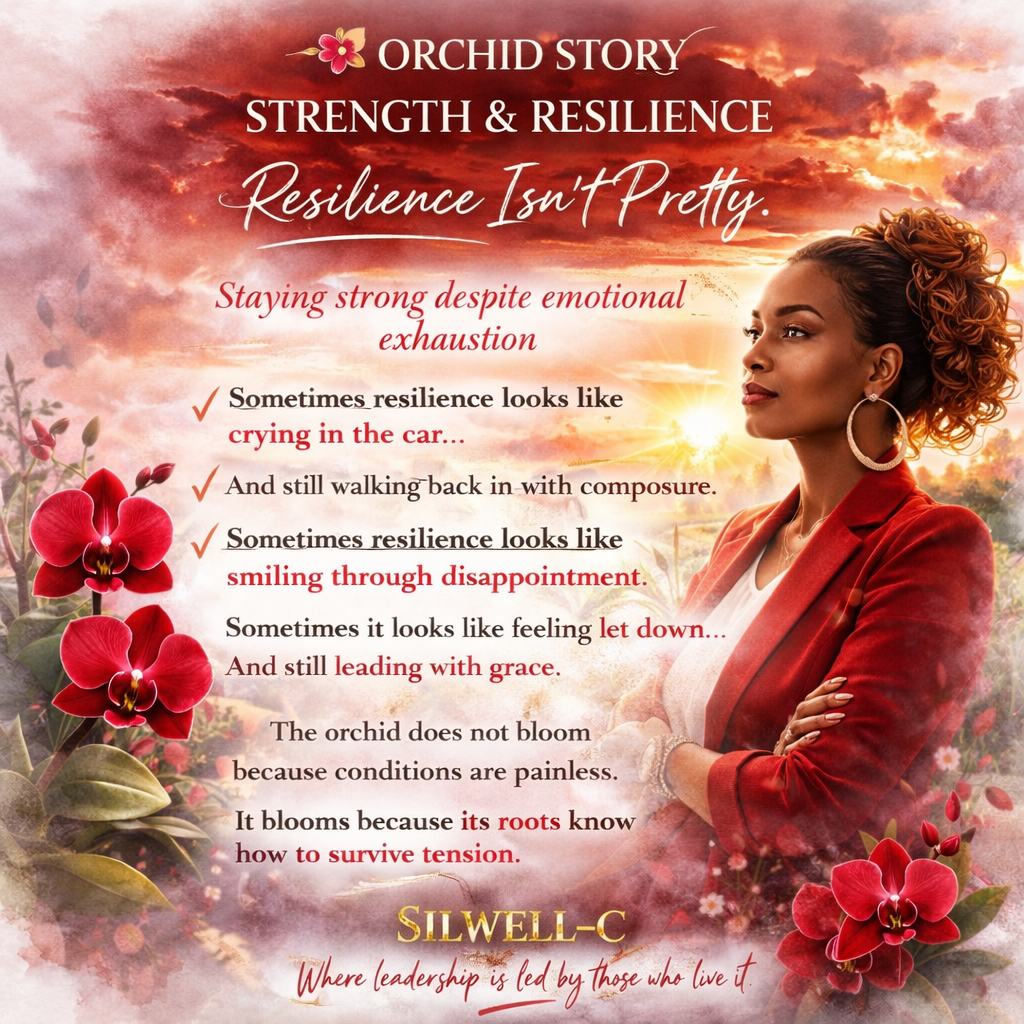
Resilience Isn’t Pretty
There comes a point when resilience stops looking inspiring and starts feeling heavy. After decades of fighting for fairness, building a career from nothing, and standing strong in systems that were not designed for you, the exhaustion becomes emotional. This Orchid Story reflects on what it means to stay rooted when opposition feels intentional and the weight feels personal.
There is a kind of strength people applaud.
And then there is the kind no one sees.
The kind that forms quietly over years of survival.
Throughout my life, I have known what it means to fight.
I fought through poverty.
I fought through doubt.
I fought through systems that were not built for someone like me, a little girl from Belize, raised with very little, but raised with dignity.
Nothing was handed to me.
Every credential.
Every promotion.
Every leadership title.
Every door I walked through, I pushed open with preparation, faith, and relentless work.
When you are young, you fight with fire.
You are vibrant.
You are energetic.
You believe stamina has no limits.
Standing up for yourself feels empowering.
But something shifts when you enter your 50s.
The fighting doesn’t feel victorious anymore.
It feels exhausting.
Because it has been decades of proving.
Decades of navigating resistance.
Decades of standing steady while others questioned your presence.
And now, when you have finally built what you worked your entire life to build, you encounter something heavier than opposition.
You encounter intentional harm.
There is a unique kind of emotional strain that comes when someone tries to take away what you built, not because you failed, not because you were incompetent, but because they decided you should not have it.
People can envy your strength.
They can envy your resilience.
They can envy your voice, your presence, your competence.
And instead of rising to their own growth, they attempt to dismantle yours.
That kind of pressure does not just sit in your office.
It follows you home.
It lingers in your thoughts.
It interrupts your sleep.
It makes you question things you never imagined questioning.
I believe in God.
I believe He sees what I cannot see.
I believe He blocks what I do not know is coming.
He has protected me my entire life.
But faith does not erase fatigue.
It does not remove the emotional toll of waking up daily knowing that negativity surrounds you.
Knowing that you must stay composed while others are careless with your livelihood.
Knowing that you are expected to function normally while someone quietly attempts to rewrite your career.
Resilience, at this stage of life, does not look glamorous.
It looks like scheduling therapy so you can gather your thoughts before they scatter.
It looks like holding yourself together in meetings.
It looks like refusing to become bitter when you have every reason to.
It looks like choosing integrity, again.
There are moments when the weight feels unbearable.
Moments when you think:
How many battles must one person fight?
I have always had the energy to stand strong.
But now the exhaustion is not physical.
It is emotional.
It is the heaviness of being misunderstood.
Of being targeted.
Of being forced to defend a career that was built brick by brick.
And yet, here is the truth.
They cannot take what God established.
They cannot erase decades of work with insecurity.
They cannot undo the resilience that was forged in childhood.
Because my strength did not begin in a boardroom.
It began in scarcity.
It began in struggle.
It began in survival.
The orchid does not bloom because the environment is kind.
It blooms because its roots are anchored.
And mine are anchored.
Resilience isn’t pretty.
It is not soft quotes and filtered sunlight.
It is tears in private.
Prayer in silence.
Strategy in the midst of pressure.
And composure when your spirit is tired.
I am tired.
But I am not defeated.
I am heavy.
But I am still rooted.
And that , even now, is strength.
Dr. Cynthia Skyers-Gordon
SILWELL-C
Where leadership is led by those who live it.
Difficulty Building Relationships Because of Distrust
Leadership doesn’t begin at the office door.
It carries the weight of our earliest experiences with trust, protection, and survival.
When those experiences include harm or betrayal, they don’t disappear, they shape how we observe, protect, mentor, and receive support.
This orchid story explores how unresolved distrust can quietly influence leadership relationships, growth opportunities, and the ability to receive what we freely give to others.
Some leadership challenges don’t begin in the workplace.
They begin in childhood.
When a child is harmed, and the person who is supposed to protect them does nothing, something fundamental breaks. Trust doesn’t just weaken; it never gets the chance to form.
As a little girl, I learned very early that speaking up did not guarantee safety. I learned that telling the truth did not automatically lead to protection. And when the person you are supposed to trust the most chooses silence, inaction, or curiosity over protection, a child internalizes a painful lesson: I am on my own.
That kind of experience doesn’t stay in childhood.
It follows you.
It shows up as watchfulness.
As silence.
As reading people closely instead of trusting words.
I became observant. I learned to read body language, tone, and patterns. I didn’t talk much; I watched. Those skills later served me well as a leader. I could read a room. I could sense tension. I could see what others missed.
But the same skill that protects you can also isolate you.
Years of harm and years of waiting for someone to step in build a deep, layered distrust. Then adulthood arrives, and relationships begin. You want to trust. You want someone to finally protect you. But people are human. They make mistakes. And when those relationships hurt too, the distrust deepens.
By the time you enter leadership, you are carrying more than a resume.
You are carrying history.
In the workplace, that history shows up quietly. You analyze everything. You question motives. You don’t take kindness at face value. When mentoring opportunities arise, instead of receiving them, you dismantle them, looking for the hidden cost. What do they want from me? Because no one has ever simply given without strings.
Over time, protective behaviors are misread. Caution is labeled as resistance. Boundaries are called aggression. And the leader becomes known as “difficult” or “hard to work with.”
Not because they are unskilled.
But because they are guarded.
Here is the paradox I lived for a long time:
I could protect others in ways I never allowed for myself.
As a leader, I fiercely advocated for my staff. I encouraged growth. I celebrated their next steps, even when those steps led them away from me. I wrote letters of recommendation with pride. I wanted to be what I never had.
Yet when that same support came toward me, I rejected it.
I could give safety.
I could not receive it.
That contradiction is not a weakness.
It is unresolved survival.
And this is where leadership requires honesty.
We bring our stories into our careers. If we don’t acknowledge them, they don’t disappear — they quietly shape our decisions, our relationships, and our reputations.
True growth begins when we recognize that our protective walls, while once necessary, may now be limiting us.
And true leadership, real leadership, requires something deeper than judgment or labels. It requires curiosity. It requires learning people’s stories before defining their behavior.
Hurt people are not bad people.
They are people who learned to survive without protection.
Mentorship without understanding is surface-level leadership.
Guidance without curiosity is control.
If you call yourself a leader, take the time to learn the story.
Not the rumor.
Not the label.
The story.
Because you cannot truly mentor someone if you don’t understand where they learned to protect themselves.
And sometimes, the most powerful leadership act is not fixing,
it is seeing.
Key Takeaway
Unacknowledged hurt doesn’t remain personal; it quietly shapes how we lead, trust, receive support, and interpret others' intentions.
Reflective Question for Readers
In what ways have you learned to give what you never received;
and how might that shape the way you lead, trust, or accept support?
Gentle References & Further Reading
(for readers who want language, understanding, or context, not rigidity)
Trauma and the Difficulty Receiving Care
Many trauma-informed frameworks explain why individuals who experienced early betrayal or neglect can become highly capable caregivers and leaders, yet struggle to receive support themselves.
This pattern is often linked to protective independence and survival-based self-reliance — where giving feels safer than receiving.
Suggested reading:
The Body Keeps the Score – Bessel van der Kolk
Explores how early trauma shapes adult relational patterns, including trust, hypervigilance, and difficulty receiving care.
Attachment, Trust, and Leadership
Attachment research shows that early disruptions in safety and protection can lead to adult patterns of vigilance, guardedness, and difficulty trusting authority figures, even when those figures are supportive.
This helps explain why mentorship may feel threatening instead of supportive.
Suggested reading:
Attached – Amir Levine & Rachel Heller
Offers accessible insight into how early attachment experiences influence adult relationships, including professional ones.
The Giver–Receiver Imbalance
Psychological research describes how some individuals become highly skilled at giving support while unconsciously rejecting it for themselves. This is sometimes discussed as asymmetrical caregiving or one-way relational safety.
Giving allows control. Receiving requires vulnerability.
Suggested reading:
Daring Greatly – Brené Brown
Addresses vulnerability, self-protection, and why receiving support can feel more threatening than offering it.
Trauma-Informed Leadership
Trauma-informed leadership frameworks recognize that leaders bring lived experiences into their roles, and that behaviors often labeled as “difficult” are frequently adaptive responses to past harm.
This directly supports your call for leaders to learn the story, not just judge the behavior.
Suggested reading:
Trauma-Informed Leadership – Howard Bath & Ruth Deans
Explores leadership through the lens of trauma, trust, and relational safety.
Being Resilient Regardless of What Happened in My Life
Resilience has always lived quietly inside me. I didn’t train for it. I didn’t choose it intentionally. It simply showed up, especially in moments when staying down would have been easier. This Orchid Story reflects on strength, resilience, and the decision to keep moving forward, regardless of what life brings.
An Orchid Story of Strength & Resilience
I’ve spent much of my life wondering where my strength came from.
It wasn’t something I consciously chose. It wasn’t something I trained for. It was simply steadiness, unyielding, and present even when life tried to convince me otherwise.
People often say children are resilient, that they bounce back easily, an idea that resilience research has long supported (Masten, 2014). And maybe that’s true. But what surprises me most is that my resilience hasn’t faded as I've gotten older. If anything, it sharpened.
No matter what has happened to me, no matter how painful, disappointing, or unfair a situation has been, I’ve never allowed myself to stay in that space for too long. I cry. I feel overwhelmed. I let myself sit in the hurt. I permit myself to grieve.
But I don’t live there.
Because I know myself well enough to know that if I stay too long in that space, it becomes dangerous. It becomes the place where self-doubt grows louder, where negative voices creep in, where motivation dissolves into stillness, something that trauma and resilience studies caution can happen when distress lingers too long (Bonanno, 2004). And I refuse to sink into a place that steals my movement.
My life hasn’t been easy, but I’m also careful with how I tell my story. I know some people have endured far more than I have. So I don’t label my life as tragic. I’ve experienced trauma. I’ve been hurt. I’ve been underestimated. But I never allowed those moments to define the limits of my future.
In fact, every traumatic experience did the opposite.
It pushed me.
When I was told I wouldn’t be anything more than a maid.
When opportunities were withheld from me, roles I knew I had earned but were intentionally denied.
When doors were quietly closed without explanation.
I didn’t retreat.
I pushed harder.
There’s something in me, something deeply rooted that refuses to accept limitation. Maybe it’s cultural. Perhaps it’s ancestral. As a Jamaican and Belizean woman, I was raised with a clear message: no one is better than you. You can learn. You can grow. You can rise, a belief system research links to resilience through identity and cultural grounding (Ungar, 2011).
And I believed that.
If someone suggests I can’t do something, something inside me ignites. How dare you tell me I can’t? That single doubt becomes fuel. If you think I lack knowledge, I will go find it. If you think I don’t have the skill, I will learn it, practice it, and implement it well, a response closely aligned with what psychologists describe as growth mindset and self-efficacy (Dweck, 2006; Bandura, 1997).
I don’t wait to be taught.
I research.
I watch.
I learn.
And then I do.
I’ve mastered skills I had never touched before simply because I refused to accept “I don’t know” as an ending. Building my business wasn’t handed to me. I didn’t rely on constant guidance. I studied. I observed. I gathered information. And I implemented step by step.
What I’ve learned over time is this: there are no unintelligent people. Some people have knowledge, and people who choose not to seek it. In a world where information lives in the palm of our hands, lack of knowledge is rarely about access. It’s about intention—something learning theory consistently emphasizes (Bandura, 1997).
And resilience lives in that intention.
That doesn’t mean I never feel defeated. I do. I have moments where the weight feels heavy. But I don’t stay down. I don’t numb myself. I don’t disappear. I come back swinging every time, which aligns with how resilience is described in the research: not as the absence of struggle, but the ability to re-engage (Masten, 2014).
That resilience is what saved me. It’s what kept me from becoming a statistic. It’s what kept me moving when stillness would have been easier.
And when I work with staff who struggle with motivation, self-worth, or belief, I wish I could hand them this drive. I wish I could embed it inside them. All I can do is speak it out loud: Show them. Prove it to yourself. Learn the skill. Apply the knowledge. Stand in your power.
Resilience isn’t about pretending things don’t hurt.
It’s about refusing to let hurt decide who you become.
Key Takeaway
Resilience is not the absence of pain, struggle, or disappointment. It is the decision to engage again, to learn, to adapt, and to refuse to let hurt determine who you become. Strength grows not because life is easy, but because you choose movement over stagnation and intention over defeat.
Reflective Notes
Resilience often goes unnoticed when it becomes familiar. We move forward without pausing to acknowledge how much strength it took simply to keep going.
Consider this:
Where have you already demonstrated resilience without naming it?
What challenges pushed you to grow rather than retreat?
How might honoring your own resilience shift the way you see yourself today?
Resilience does not require perfection. It requires presence, reflection, and the courage to continue.
References
Bandura, A. (1997). Self-efficacy: The exercise of control. New York, NY: W.H. Freeman.
Bonanno, G. A. (2004). Loss, trauma, and human resilience: Have we underestimated the human capacity to thrive after extremely aversive events? American Psychologist, 59(1), 20–28.
Dweck, C. S. (2006). Mindset: The new psychology of success. New York, NY: Random House.
Masten, A. S. (2014). Ordinary magic: Resilience in development. New York, NY: Guilford Press.
Ungar, M. (2011). The social ecology of resilience: Addressing contextual and cultural ambiguity of a nascent construct. American Journal of Orthopsychiatry, 81(1), 1–17.

Pushing Through Pain and Just Keep Going No Matter What
I learned resilience by necessity. As a child, I faced trauma, bullying, and constant messages telling me I wouldn’t become anything. As I entered leadership roles, that same strength was misinterpreted, challenged, or minimized, but I never stopped advocating for others. This story explores how pain can become purpose, and why leaders must look beyond performance to understand the hidden battles their staff are fighting. Strength is often silent, but it is always present.
Soft hearts and steady spines carry us through. This mood honors your quiet strength, the power to stay flexible without losing your form. Here you’ll find reflections that help you bend when needed, breathe through challenge, and return stronger, not harder.
Strength & Resilience: Rising Beyond the Hurt
Content Note: As you read, consider the unseen battles your coworkers and staff may carry, and what leadership looks like when we lead with understanding rather than judgment
From the earliest days of my childhood, I carried invisible wounds. I experienced sexual assault. I immigrated to a new country and faced further abuse. I lived under the expectations of adults whose approval I sought and under the bullying of peers who made me feel unseen. Something inside whispered: You’re not enough. And yet another voice replied: Watch me.
And that voice followed me into my professional life.
Throughout my career in early childhood education, in roles as director, education coordinator, and education manager, I have encountered leaders who struggled with the strength I demonstrated and the confidence I projected. They didn’t know the story behind that strength. They didn’t know what I had overcome to stand where I stood. Some worked to discredit, diminish, or overlook me. I continued to fight, not just to keep my title, but to keep uplifting the staff I led.
People saw a capable leader.
They did not see how hard I had to fight behind the scenes just to be one.
But I never gave up.
I knew God placed me in leadership for a purpose, to support those who remind me of the child I once was. To help others recognize their gifts before doubt steals their belief. I often think of the children growing up in places like where I was raised, places like Compton, where many are told they will never be anything. I know that voice all too well.
We all have potential.
Sometimes we are a little rough around the edges, but our hearts are pure.
What we need are mentors, not critics. Leaders who can see past the imperfections long enough to nurture the promise inside. If every leader could pause, step back, and choose to see potential instead of flaws, imagine what workplaces could become.
And so my resilience is more than persistence. It is my mission to ensure that no staff member, no child, no person has their potential minimized because someone else cannot recognize their worth.
Wellness Insight
Resilience is not simply enduring; it’s transforming pain into purpose. The narrative of survival, when shared, becomes a leadership asset. In fact, research confirms that authentic storytelling in leadership fosters resilience, enhances engagement, and builds psychological safety in teams. SpringerLink+1
Additionally, leadership style matters: servant-leadership practices, which emphasize supporting others, recognizing their worth, and building community, are positively linked to employee resilience and engagement. PMC+1
Reflection for Readers
What hidden pain have you carried that still drives you forward?
In what ways are you proving something, to yourself or to others, instead of embracing who you already are?
How can you transition from proving your worth to believing your worth and supporting others in believing theirs?
Key Takeaway
You are resilient because you keep going.
You are powerful because your pain became your purpose.
And the next step is not simply to persist, it is to guide others with your persistence.
Organizational Bridge to SILWELL-C
This story reminds us that within every organization, there are staff members silently proving their worth rather than being seen for their inherent value. Leadership that only rewards performance misses the deeper human story at play. With SILWELL-C, organizations build cultures where hidden strength is acknowledged, not simply tolerated, where resilience becomes part of the fabric, not just the outcome.
Organizational Reflection
Who among your team is silently proving rather than belonging?
Which structures reward relentless output but ignore emotional well-being?
What can you implement to shift from valuing what they do to valuing who they are?
Where story meets science, strength grows through understanding.
Kampmann, A. (2022). Using Storytelling to Promote Organizational Resilience. Springer. SpringerLink
Zigarmi, L. (2010). Storytelling at Work: A Leadership Offer for Well-being. University of Pennsylvania. repository.upenn.edu
“The Effect of Servant Leadership on Work Resilience.” (2022) Frontiers in Psychology. PMC
“How Servant Leadership Predicts Employee Resilience in Public Organizations.” (2022) Current Psychology. PubMed

The Day I Stood Up
When I moved from Belize to America, everything about me made me stand out, my accent, my limp, my quiet nature. I was teased for being different, but one day, I chose not to shrink anymore. That moment didn’t make me angry, it made me strong. Strength, I learned, isn’t loud. It’s the quiet choice to reclaim your dignity and find your voice, not to harm, but to heal.
Soft hearts and steady spines carry us through. This mood honors your quiet strength, the power to stay flexible without losing your form. Here you’ll find reflections that help you bend when needed, breathe through challenge, and return stronger, not harder.
Soft heart, steady spine.
Sensitive Topic: This story contains references to childhood bullying and physical discipline.
When I moved from Belize to America at the age of six, everything about me made me stand out. My accent. My limp. My quiet nature. Kids didn’t understand my culture, and back in the late 1980s, differences weren’t celebrated. It was teased. Every day after school, I was pushed, called names, and mocked for how I spoke and walked.
I didn’t fight back. My aunt was strict and had warned me that if I ever caused trouble, she’d show up at school with a belt. So, I held it in, but the teasing didn’t stop. I remember one afternoon, she came to pick me up and saw a group of kids walking behind me, laughing. That day, she told me not to let anyone bully me again.
Her words confused me. How can I protect myself while still following her rules? But the next time it happened, something inside me changed. I was in sixth grade when a girl said something cruel about my mother, and I snapped. I fought back. That was the first fight I ever had, and though I dreaded the consequences, I felt something I hadn’t felt before: power.
The next day, I was called to the office. The principal gave me two options: take six swats with a paddle or have them call my aunt. I took the swats. I was sore, but for the first time, I wasn’t scared.
That day changed me. It didn’t make me violent; it made me aware. Aware that standing up for yourself isn’t about anger. It’s about reclaiming your dignity. It’s about no longer letting fear define your worth.
I learned how to code-switch between dialects, how to blend in when I needed to, but more importantly, I learned that strength doesn’t always roar. Sometimes it’s the quiet decision to stop running, turn around, and say, Enough.
“That day, I learned strength isn’t loud. It’s the quiet choice to no longer shrink.”
Bullies feed on silence. That day, I found my voice, not to harm, but to protect. Sometimes resilience begins the moment you stop shrinking to make others comfortable.
Where story meets science, strength grows through understanding.
Resilience is the ability to adapt well to adversity; many people also experience post-traumatic growth, develop new strengths, and find meaning after hardship.
Good sources: APA on resilience; Tedeschi & Calhoun’s post-traumatic growth research. American Psychological Association+1